
Workplace Systems and Survival Framework 1-8
Workers Edition (WSSF 1-8)
Frameworks 1 & 2 (Ethical Authenticity & Compassionate Accountability): These form the structural foundation that binds all elements of the organisation. Genuine and empathetic interaction act as the core stabilizing posts that prevent systemic collapse under pressure. Without these foundational procedures, the wider structure loses its integrity.
Framework 3 (Credible Leadership): The visionary driver of the organisation. A credible leader actively restructures failing systems, navigates complex challenges, and aligns operational rules with the reality the workforce experiences to protect the team.
Framework 4 (Authentic Compassion and Relational Consultation): This represents the Company Culture, shared values, and genuine communication necessary to reach strategic goals. It acknowledges that strategy alone is insufficient; without deep relational connection and trust, an organization cannot successfully navigate to its destination.
Framework 5 (Integrated Systems and Leadership in Practice): This is the vital act of binding the organisation together. It represents the critical connection between physical operations and logistics, as well as the team's underlying cultural resonance. This integration holds the system steady and maintains structural integrity under sustained pressure. Focusing on where you are now promotes an active ‘to be’ mentality in a team environment.
Framework 6 (Human-Centered Digital Leadership): Defined by "ground-truth validation." It requires rigorously testing algorithmic outputs, automated metrics, and executive dashboard data against the real, lived conditions people experience on the shop floor.
Framework 7 (Whole-of-Life Wellbeing): This focuses on collective stewardship and biological sustainability. It emphasizes that protecting boundaries and operational recovery time is non-negotiable for the workforce's long-term survival and vitality.
Framework 8 (Psychosocially Safe Change): Poorly managed organisational change is linked to systemic suffocation. It recognizes that forcing unconsulted restructuring creates a toxic hazard within the organization and ensures change is managed safely to prevent workforce breakdown. Integrated systems are organised and scheduled to allow change to occur at a natural pace, isolating cognitive overload.
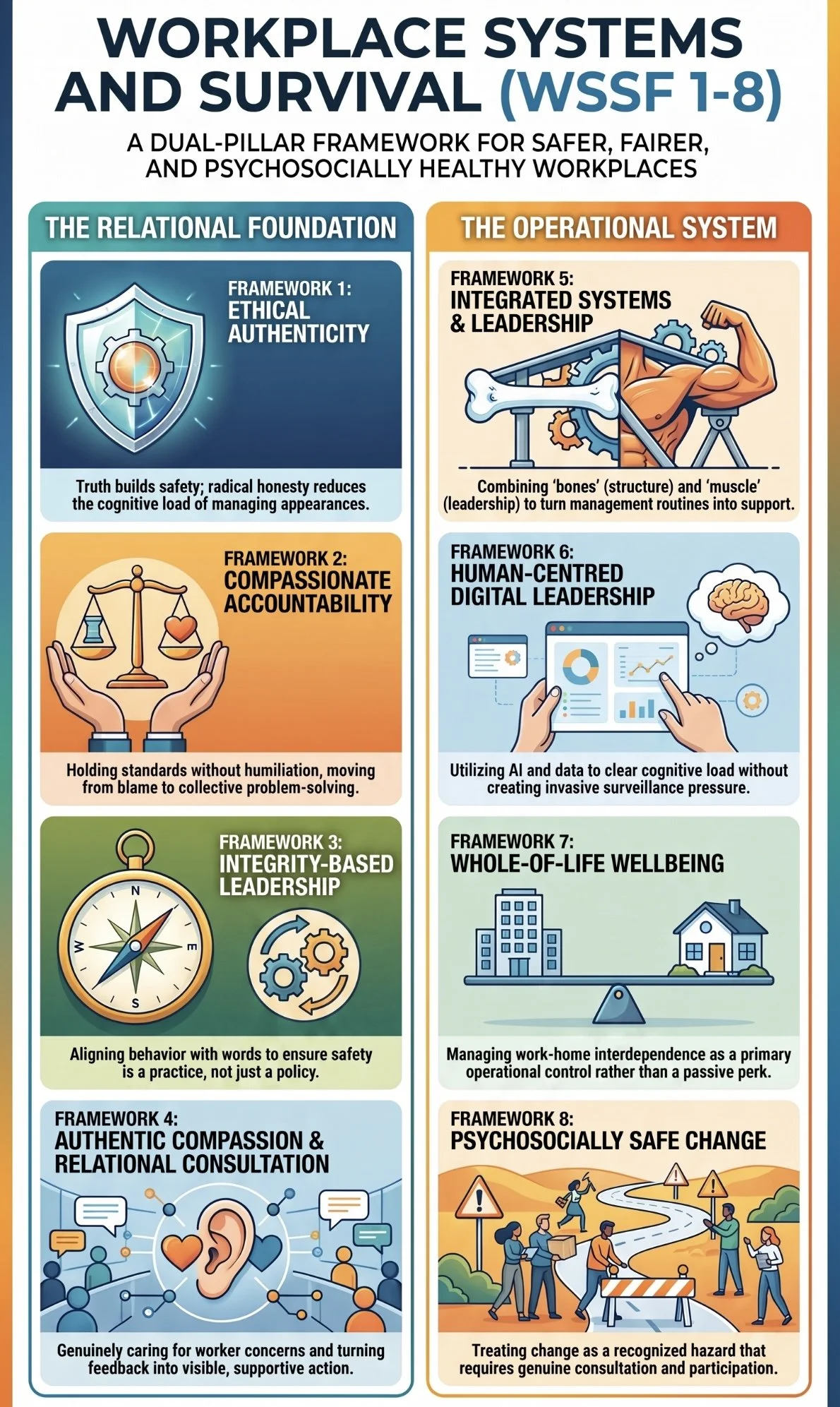
The Relational Foundation (Frameworks 1–4)
Focus: Trust, Culture, and Interpersonal Architecture
This first section focuses entirely on the human element of the organization. It establishes the relational safety and behavioral standards that must be met before any operational pressure is applied. By embedding ethical authenticity, compassionate accountability, and integrity-based leadership, this stack ensures that leaders are credible and transparent. Culminating in Authentic Compassion and Relational Consultation, it guarantees that communication is a genuine two-way street, transforming abstract corporate values into lived, shop-floor reality. Without this stack, the workforce will not trust the system.
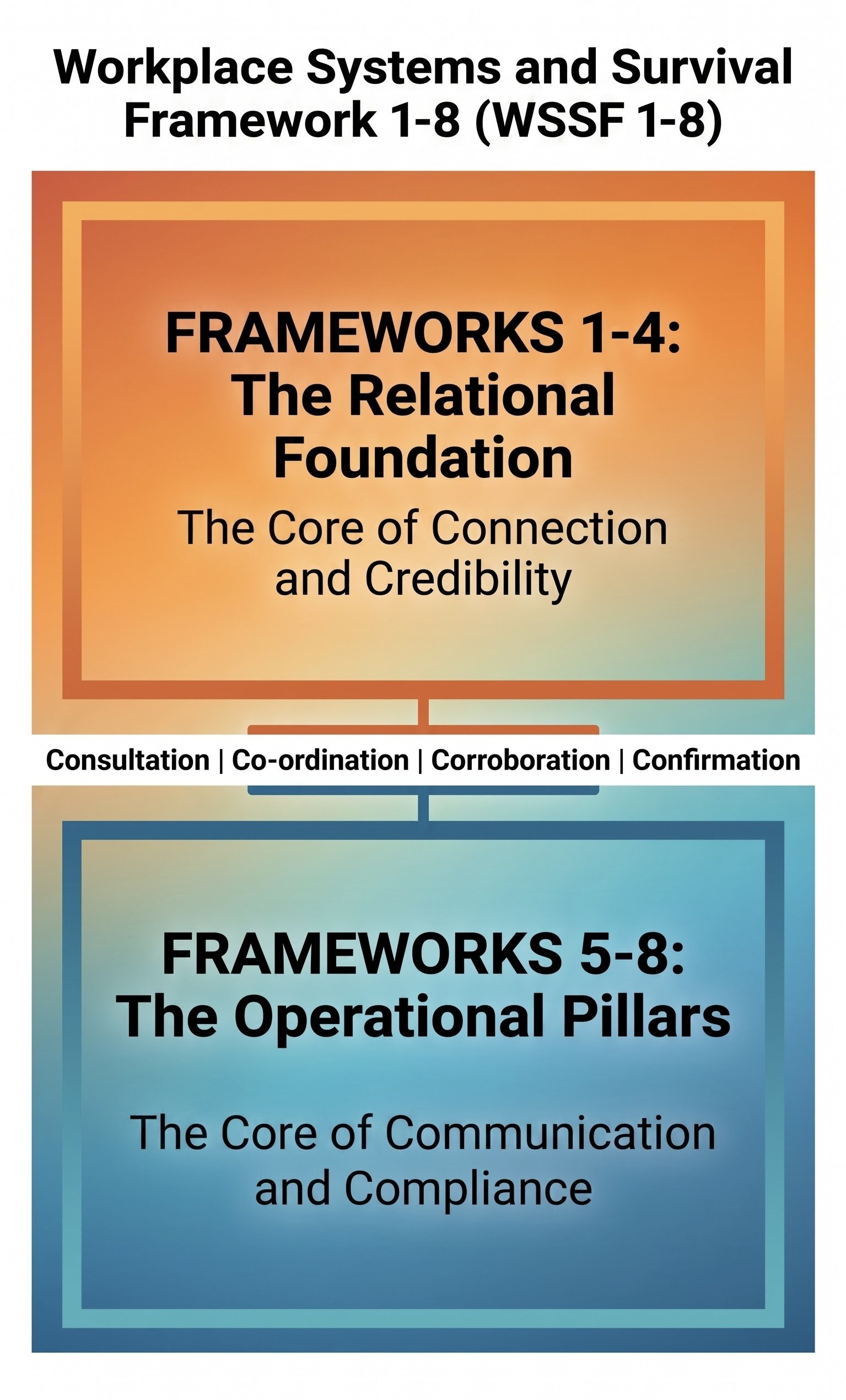
The Systemic Execution (Frameworks 5–8)
Focus: Operations, Design, and Structural Protection
While the first section builds trust, the second section enables safe passage. Here, we govern the physical and digital systems that determine how work is done. It bridges the gap between safety theory and daily logistics, ensuring that digital tools support human judgment rather than exhaust it. By strictly safeguarding whole-of-life well-being and treating organizational change as a psychosocial hazard, this stack ensures the corporate structure remains stable, compliant, and protective, even during periods of severe turbulence. Without the foundation and the ability to navigate freely, the organization cannot survive the storm.