
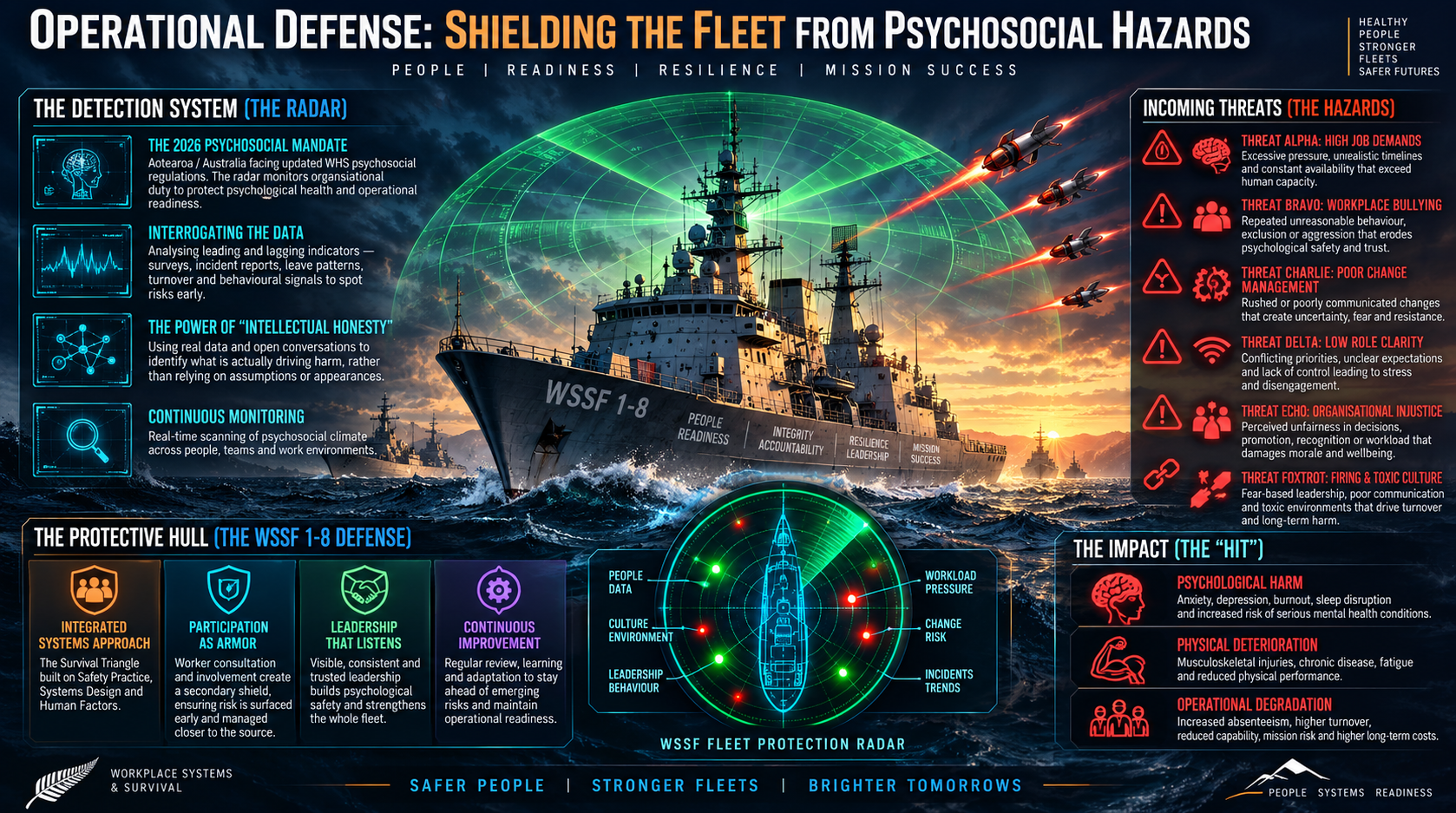
Toolbox 1: The Field & Floor System
Section 1: Overview & Scope
Target Audience: Frontline Workers, Team Leaders, and Shift Supervisors (covering responsibilities across all levels of the workplace, including PCBUs and Upstream Duty Holders)
Statutory Scope: WHS Act (NSW/Model) Primary Duty of Care (Section 19), Upstream Duties (Sections 20–26), Officer Due Diligence (Section 27), Worker Duties (Sections 28–29), and Mandatory Consultation & Representation (Sections 46–50).
Core Concept (The Agile Military Metaphor): This concept connects the rigid, top-down command structure (which includes non-delegable legal duties) with agile, frontline sensor networks that gather real-time worker feedback. It moves beyond compliance checks by creating a two-week operational cycle that turns consultation into effective risk management on the floor.
📦 What Is Inside the $75 Download?
This isn't a static template—it is a complete, step-by-step frontline activation toolkit structured across 7 high-density operational sections:
🔄 The Two-Week Field System Mechanics: A practical fortnightly rhythm that alternates between building genuine trust (Stack A: The Compliance Anchor) and turning real feedback into physical floor improvements (Stack B: The Compliance Chain).
👁️ The 4 Layers of Discernment: Simple guidance to help your workplace move past "appearance managing," teaching individuals, crews, and leadership how to focus on real floor conditions rather than clean paperwork.
🚦 The Room-Reading Guide (Green vs. Red Flags): Warm, intuitive coaching for supervisors to recognize true relational trust (unscripted, honest feedback) versus silent disengagement—complete with immediate Mateship Pivot Scripts.
🔍 The Ambiguity Detector: Plain-language tools that lean on the Australian ethos of mateship to clear up vague instructions, protect your crew from hidden psychosocial stress, and build clear task ownership.
📊 The Post-Toolbox Reality Check: A quick, 60-second self-assessment that lets team leaders reflect honestly on their sessions and track the genuine cultural health of their crew.
🚀 Supervisor Coaching Strategies: Practical ways for business owners and managers to support team leaders—protecting their time with the 10-Minute Rule and helping them transition from "Safety Cops" to supportive coaches.
🧠 The KSA Competency Matrix: A clear, reassuring roadmap of the Knowledge, Skills, and Abilities frontline leaders and executive governors need to maintain a calm, well-run, and safe workspace.
🌐 Integrated Resources & Value
Your download brings together five powerful, interconnected resources:
Stack A – The Compliance Anchor: Fuses statutory WHS requirements (Sections 19–30) with human psychology, protecting both physical safety and personal wellbeing.
Stack B – The Compliance Chain: Translates WHS Sections 46–50 into an active, supportive consultation loop across teams, contractors, and supply chains.
Supervisor Sergeant at Arms Instructions: An easy-to-follow field guide equipping leaders to facilitate authentic conversations without needing to be safety academics.
WSSF 1–8 (Workers Edition): Integrates core framework values—from Ethical Authenticity and Compassionate Accountability to Psychosocial Safety and Whole-of-Life Wellbeing.
Māui and the Sun – The Three Women of Pulotu: Weaves ancestral wisdom, narrative strength, and human resilience into everyday workplace safety.
🎯 Who Is This For?
Business Owners & Directors looking for a genuine, legally defensible way to demonstrate active frontline consultation without spending thousands on external audits.
Operations & Warehouse Managers who want to reduce stress, improve daily communication, and remove friction on the floor.
Supervisors & Team Leaders who want a quick 10-minute method that makes team chats feel natural, open, and worthwhile.
💰 Unmatched Value for Your Business
Consultants often charge thousands for generic advice that never quite fits your crew. For $75, Toolbox 1 gives you a complete, reusable operational engine that protects your workforce, lowers psychosocial hazards, and strengthens your business culture from the ground up.
No pretense. No corporate fluff. Just honest, practical safety that works.
Section 2: What Is in the Pack
[Operating Rhythm] The Two-Week Field System Mechanics: Fortnightly cycle alternating between trust-building (Stack A: Compliance Anchor) and physical hazard resolution (Stack B: Compliance Chain).
[Diagnostic Guide] The 4 Layers of Discernment: Practical tools to move past performative paperwork and detect frontline physical and psychosocial hazards.
[Supervisor Tool] Room-Reading Guide & Pivot Scripts: Coaching guide with conversation-reset prompts to spot silent disengagement on the floor.
[Clarity Template] The Ambiguity Detector: Plain-language matrix to resolve vague directives, reduce task friction, and enforce ownership.
[Evaluation Tool] Post-Toolbox Reality Check: 60-second operational pulse check to verify shift engagement and session impact.
[Leadership Guide] Supervisor Coaching Strategies (The 10-Minute Rule): Practical roadmap shifting supervisors from compliance enforcers to trusted field coaches.
[Competency Matrix] Frontline KSA Matrix: Core roadmap of Knowledge, Skills, and Abilities required to maintain a safe, calm shift.
[Included Framework Guides]: Supervisor Sergeant at Arms Instructions (Field facilitation manual)WSSF 1–8 (Workers Edition)Māui and the Sun – The Three Women of Pulotu (Frontline culture manual)
Toolbox 2: The Governance Engine & Frontline Blueprint
Section 1: Overview & Scope
Target Audience: Shift Supervisors, Operations Managers, Safety Superintendents, and PCBUs / Executive Officers.
Statutory Scope: WHS Act 2011 (NSW/Model) — Primary Duty of Care (Section 19), Officer Due Diligence (Section 27), and Deep Consultation Frameworks (Sections 46–50).
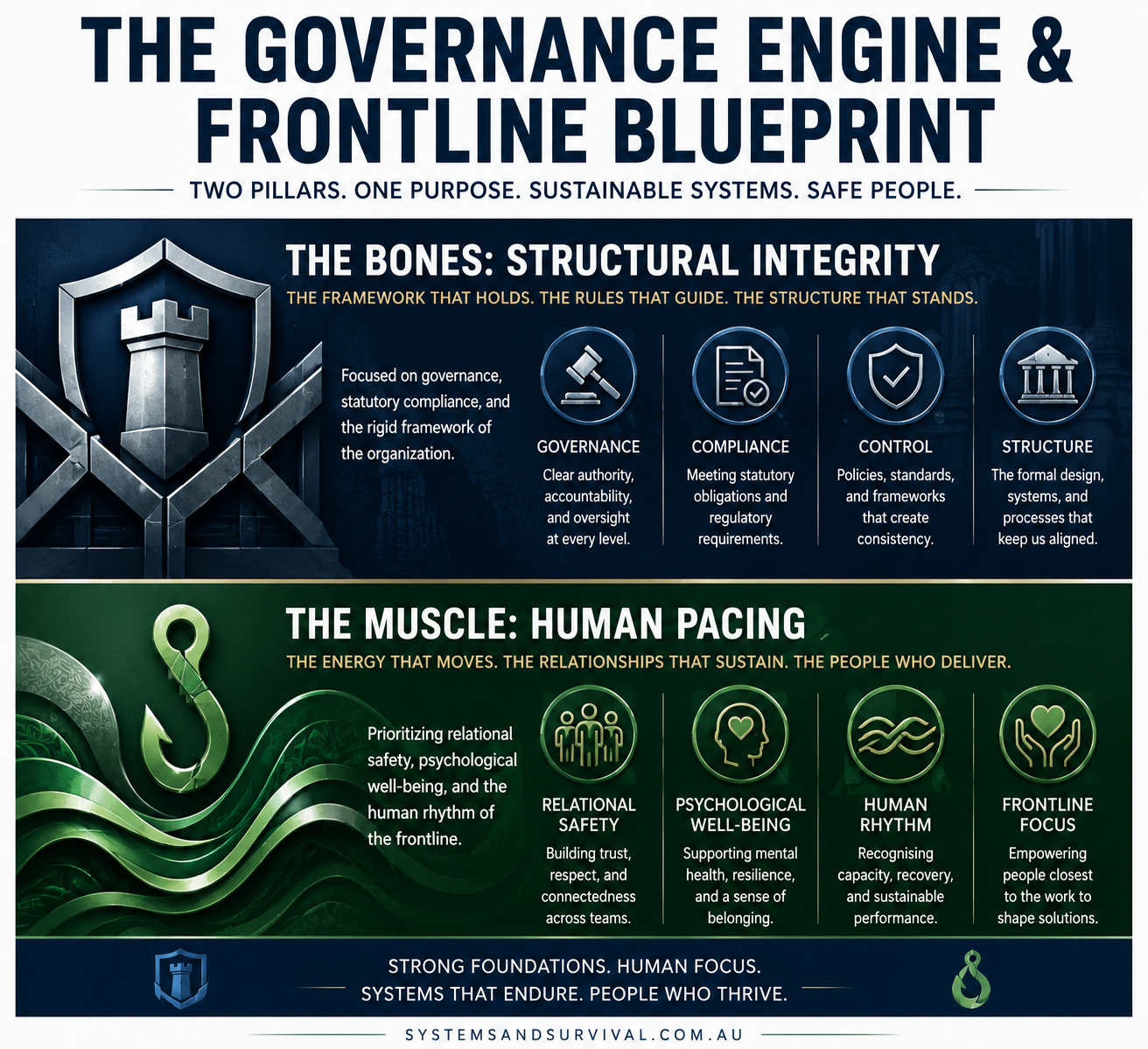
The Core Hook (Naval Command & Dual Hemispheric Archetypes): A combined military/naval compliance architecture designed to survive operational crisis (the 536 AD dark sky event). It balances King Arthur in the North (The Bones: transparent round-table governance and non-negotiable structural equality) with Māui in the South (The Muscle: disciplined pacing, collective endurance, and frontline relational trust) to manage psychosocial strain and ensure hazard reporting flows without fear of reprisal.
Toolbox 2: The Governance Engine & Frontline Blueprint
An Integrated System of Duty, Consultation, and Floor-Level Safety (WSSF 1–8)
OVERVIEW & MYTHIC FRAMEWORK
Modern workplace survival requires bridging the rigid, structural duties of governance with the fluid, adaptive realities of human culture. Toolbox 2 synthesises two ancient archetypes of survival to conquer modern workplace strain:
⚔️ King Arthur in the North:The Round Table & The Shield — Representing non-negotiable equality, structural boundaries, statutory duties, and institutional integrity (The Bones).
🪝 Māui in the Southern Hemisphere:The Waka & Taming the Sun — Representing adaptive relational cohesion, fiercely protected pacing, frontline ingenuity, and human spirit (The Muscle).
Together, they map the 14 Modern Psychosocial Hazards into an integrated, floor-level system of safety, consultation, and WHS compliance from the boardroom to the frontline.
The 5-Part Download Suite
PART 1 | Executive & Systems Command
📄 Toolbox 2: The Governance Engine — Integrated Systems
Focus: Statutory duties, PCBU Officer Due Diligence (WHS Act Sec 19 & 27), and board-to-floor governance loops anchored in Arthurian structural integrity.
PART 2 | Operational Command & Architecture
📄 Toolbox 2: Operational Design and Compliance Architecture
Focus: Tactical systems design, naval-grade mapping, and engineering compliance into daily workflow execution.
PART 3 | Strategic & Psychosocial Framework
📄 Toolbox 2: Surviving the Dark Sky
Focus: ISO 45003 international standards, bridging Arthur's Round Table and Māui's Waka (The Lashings, Hulls & Mast) to navigate systemic strain and dark sky environments.
PART 4 | Hazard Control & Floor-Level Diagnostics
📄 Toolbox 2: The Psychosocial Survival Blueprint
Focus: Plain-language hazard translation (The Crush, The Grind, The Void, The Goalpost Shift) and practical risk mitigation for supervisors and crews.
PART 5 | Frontline & Floor Execution
📄 Toolbox 2: Workplace Survival Blueprint — The Frontline
Focus: Floor-level relational safety, "Own It, Fix It, Move On", and daily pre-start consultation tools.
Section 2: What Is in the Pack
[Governance Suite] Part 1–5 Governance Suite (.pdf): End-to-end implementation guides covering statutory duty mapping, naval compliance architecture, and crisis navigation.
[Executive Diagnostic] Comparative Leadership Matrix: Visual tool contrasting hierarchical failure modes against flat, psychologically safe operational structures.
[Automated Tool] WSSF Supervisor Audit Checklist (.xlsx): Excel dashboard to audit frontline compliance, hazard controls, and supervisory consultation.
[Roadmap] Implementation & Cadence Guide: Complete operational rollout plan structured across a 4–6 week shift cycle.
[Included Framework Guides]:WSSF 1–8 (Management & Operational Edition)
Māui and the Sun – The Three Women of Pulotu (Leadership narrative manual)
Toolbox 3: Processes (The Adaptive Controls)
Section 1: Overview & Scope
Target Audience: Company Directors, Safety Executives, HSRs, Systems Architects, and Operations Leaders.
Statutory Scope: ISO 45003 (Psychosocial Risk Management — Clauses 6.1.2.1 & 8), NSW WHS Amendment (Digital Work Systems) Act 2026, and WHS Act Section 27 Due Diligence.
The Core Hook (Global Standards & Dual-Hero Systems Architecture): A global-standard operational engine combining international ISO 45003 benchmarks with Australian psychosocial hazard legislation. Utilising the twin archetypes of the Northern (Arthurian system controls) and Southern (Māui pacing mechanisms) Hemispheres, it regulates algorithmic workflow, prevents digital cognitive fatigue, and governs organisational restructuring so automated systems protect rather than exploit the workforce.
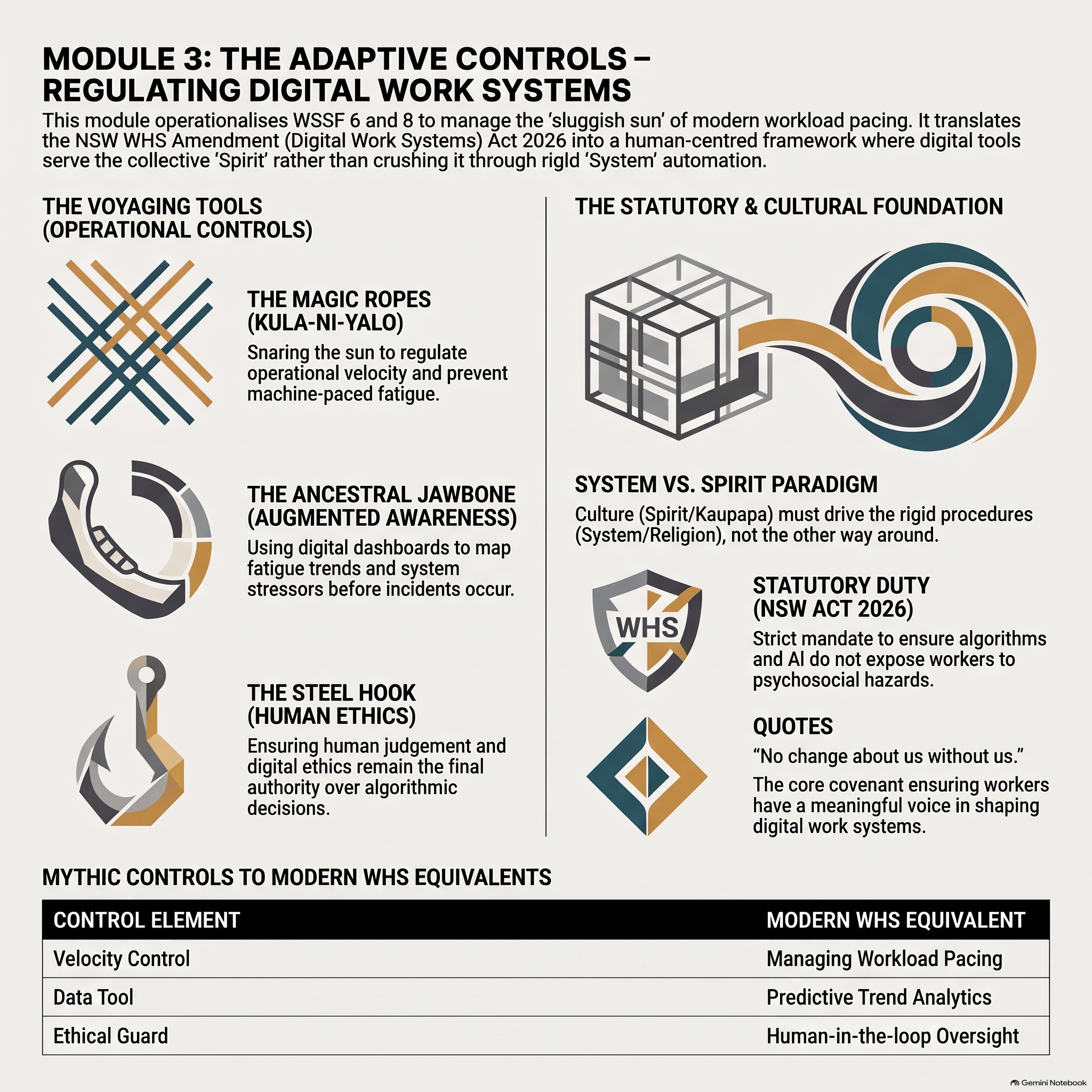
Toolbox 3: Processes (The Adaptive Controls)
A premium, audit-ready operational package designed to actively manage task pacing, digital cognitive loads, and corporate restructures in strict compliance with the NSW WHS Amendment (Digital Work Systems) Act 2026 and ISO 45003 [Syllabus, Digital Audit Checklist]. This pack bridges modern safety standards with the epic metaphor of Māui’s Sun-Binding to ensure technology and algorithms serve your team, rather than creating invasive surveillance and burnout [Digital Audit Checklist].
What is in the Pack:
📊 Corporate Slide Deck: A highly visual 6-slide seminar presentation detailing the "System vs. Spirit" technology paradigm, digital fatigue, and situational pacing controls [WSSF 6 Slide Deck].
📝 Change Transition Template (.docx): An editable, 11-node operational planning workbook to map workload spikes and secure a safe transition pathway [WSSF 8 Template].
🔍 Digital Risk Audit Checklist (.pdf): A 6-point compliance checklist for Health and Safety Representatives (HSRs) to systematically audit automated scheduling, AI, and GPS tracking [Digital Audit Checklist].
📈 Master Risk Register (.xlsx): A quantitative Excel backend featuring an automated Safe Work Australia risk-rating calculator (Exposure × Frequency × Severity) and live training rosters [Syllabus].
🎨 Sun-Binding Pacing Poster (.pdf): A bold, high-contrast lunchroom poster translating Māui's "Steel Hook" and "Magic Ropes" into floor-level guidelines to protect off-shift recovery [Māui's Poster].
🤝 Site Declaration & Sign-off (.pdf): A formal worker-supervisor joint training commitment to log data honestly and protect the team's digital perimeter [Wasteland Survival Blueprint].
🎧 Commute Briefing (Audio): A 5-minute conversational podcast briefing exploring the 540 AD volcanic winter and how ancestral tools translate into modern, human-centred safety controls [Syllabus].
Section 2: What Is in the Pack
[Presentation] Corporate Executive Slide Deck (.pptx): 6-slide visual seminar detailing the "System vs. Spirit" technology paradigm, digital fatigue, and situational pacing.
[Workbook] Change Transition Template (.docx): Editable 11-node operational workbook to map workload spikes and execute defensible structural restructures.
[Audit Tool] Digital Risk Audit Checklist (.pdf): 6-point compliance audit for HSRs to evaluate automated scheduling, AI task dispatch, and digital surveillance.
[Calculator] Master Risk Register (.xlsx): Quantitative risk engine featuring an automated Safe Work Australia matrix (Exposure × Frequency × Severity) and training registers.
[Workplace Poster] Sun-Binding Pacing Poster (.pdf): High-contrast site poster operationalizing Māui’s pacing rules to protect recovery and off-shift downtime.
[Governance Sign-off] Site Declaration & Sign-off (.pdf): Formal worker-supervisor training accord establishing digital boundary protections.
[Audio Briefing] Commute Audio Briefing (MP3): 5-minute executive audio briefing translating ancestral crisis survival into technical psychosocial controls.
Toolbox 4: The Global Survivor Series (Parts 1–7 Enterprise Suite)
Price: A$99.00
Safety is the measure — Survival is the destination.
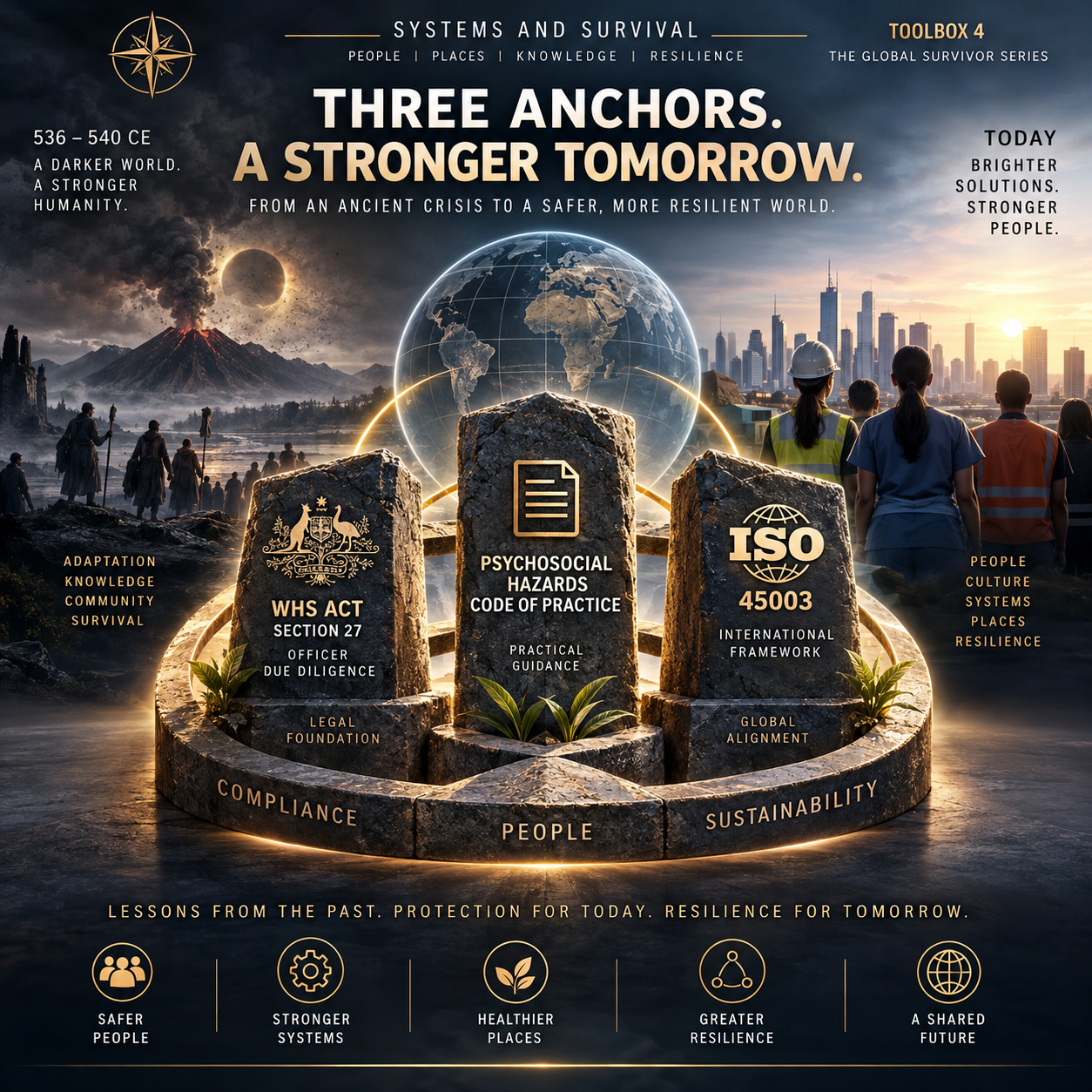
When the sun was blotted out across seven continents during the 536–540 CE volcanic winter, human survival did not depend on individual heroism—it depended on structural buffers, non-punitive accountability, and collective pacing. Toolbox 4 delivers the complete multi-jurisdictional operating system translating all 14 Safe Work Australia psychosocial hazards and ISO 45003 clauses into defensible, shift-floor routines.
What This Enterprise Suite Delivers:
Strategic Synthesis Reports (Parts 1–7): Seven continent-anchored operational frameworks (Africa, Asia & Middle East, Europe, Oceania, South America, North America, and Aboriginal Australia) mapping deep-time systemic resilience to modern high-stress work design.
Executive Slide Decks: Clean, 6-slide presentation packages for boardrooms, PCBUs, and safety committees.
The 14 Psychosocial Hazards Master Crosswalk: Direct work-design controls addressing workload pacing, role ambiguity, isolated work, and digital exhaustion.
Quantitative Audit Engines & Registers: Excel-based compliance dashboards, African Governance audit registers, and the Officer Say-Do Audit Tool for Section 27 Due Diligence.
Audio Briefings & Case Studies: Deep-dive overviews exploring restorative corporate safety and deep-winter survival economics.
Master Training Protocol Template (v2): Featuring the Two-Tier Growth Loops (Closed Loop: Listen → Learn → Do vs. Open Loop: Listen → Learn → Do → Teach), the 90% Rule, the Triad of 5s (5 Rs, 5 Cs, 5 Ps), and the auditable tripartite sign-off gate.
Statutory Compliance Anchors: Model WHS Act (ss 19, 27, 47–49) | NSW WHS (Digital Work Systems) Act 2026 | ISO 45003:2021 | NDIS Safeguards | NZ HSWA 2015.
The 7-Continent Architecture & 14 Hazards Crosswalk
Part 1: Africa (Relational Ecology) — Hazards: Poor Organisational Justice & Inadequate Reward/Recognition. Controls: Mwene/Nganga Dual Engine, Omolúwàbí Character Architecture, Ubuntu Restorative Justice & Kgotla Assemblies. (ISO 45003 Cl. 5 / WHS s 27).
Part 2: Cradle of Civilisation (Processes & Pacing) — Hazards: High Job Demands & Poor Workplace Relationships. Controls: Aksumite 85% Capacity Ceiling Buffers, Hapi Target Re-baselining & Arabian Majlis Pre-Starts. (ISO 45003 Cl. 6.1.2.1).
Part 3: Europe (Culture & Crisis Adaptability) — Hazards: Toxic/Harmful Leadership & Environmental Stressors. Controls: Arthurian Round Table Flat Consultation, Gaelic Monastic Sanctuaries & Norse Antifragile Wyrd. (ISO 45003 Cl. 6.1.2.2).
Part 4: Oceania (Human-Centred Technology) — Hazards: Low Job Control & Remote/Isolated Work. Controls: Māui’s Steel Hook (Human Ethical Override), Banyan Ropes Pacing & Madagascar Double-Outriggers. (NSW Digital Work Systems Act 2026 / ISO 45003 Cl. 6.1.2.3).
Part 5: South America (Safe Change) — Hazards: Poor Organisational Change & Intrusive Connectivity. Controls: Inca Moray Stepped Terraces (Phased Pilot Gateways), Target Relief & Kandake Digital Disconnect Curtain. (ISO 45003 Cl. 8.2).
Part 6: North America (Support & Redundancy) — Hazards: Poor Support (Ghosting) & Lack of Role Clarity. Controls: Woodlands Longhouse Single-Line Reporting, Puebloan storage cists, and potlatch resource distribution. (ISO 45003 Cl. 7).
Part 7: Aboriginal Australia (Risk Intelligence) — Hazards: Inadequate Consultation & Bullying/Unsafety. Controls: Songline Living Risk Maps, Dadirri Deep Relational Listening & Seven Sisters Peer Workload Shielding. (ISO 45003 Cl. 4 & 5.4).
Key Operational Mechanics
The Skills Split (Bifurcated Architecture): Hardcodes structural PCBU controls (The Bones: pacing caps, disconnect curtains, circuit-breakers) separately from frontline relational habits (The Muscle: Dadirri listening, Ubuntu error handling).
Root Cause Analysis (RCA) Incident Protocol: Dual-pathway response replacing punitive blame with diagnostic engineering ("Own It, Fix It, Move On" or diagnostic assemblies).
Package Format & Deliverables
Instant digital download containing full 7-part strategic synthesis reports, executive slide decks, 14-hazard threat registers, automated Excel audit dashboards, and editable Word SOP templates.